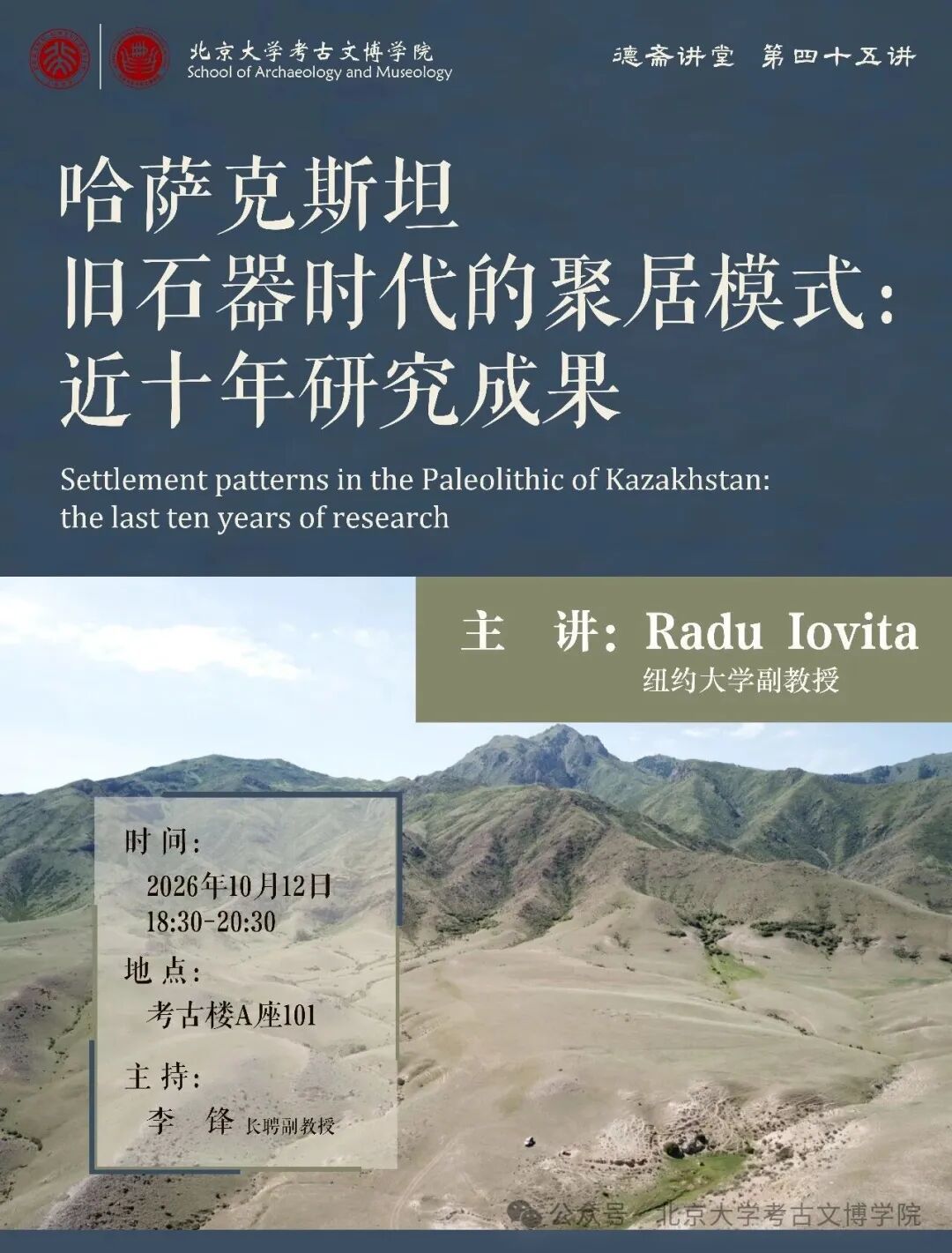
 Time
Time: 18:30-20:30, October 12, 2026
Venue: Room 101, Building A, School of Archaeology and Museology
Host: Li Feng
Tenured Associate Professor, Peking University
Speaker: Radu Iovita
Associate Professor, New York University
Introduction:
Central Asia is emerging as a crucial region for understanding population dynamics during the Paleolithic, because it lies at the intersection of the geographical ranges of Neanderthals, Denisovans, and modern humans. Kazakhstan occupies approximately 68% of the area of the five post-Soviet Central Asian states, but has received less scholarly attention and contains fewer documented sites than other Central Asian countries. This talk will recount the history of research in the region and the geographic and geological constraints of the region, before delving into the results of our ten-year field campaign aimed at reviewing the record and discovering new sites. The talk will end with perspectives on future work from predictive modeling to fieldwork and excavations.
Speaker profile:
Radu is a four-field trained anthropological archaeologist with broad interests in the archaeology of human evolution, human-environmental interactions, and stone tool technology. He came to NYU after eight years as a postdoc and eventually Senior Research Scientist at the Leibniz Research Institute for Archaeology in Castle Monrepos, Germany. He currently directs the European Research Council-funded PALAEOSILKROAD project in Kazakhstan, which investigates the role of geography and climate in Late Pleistocene human dispersals in central Asia.