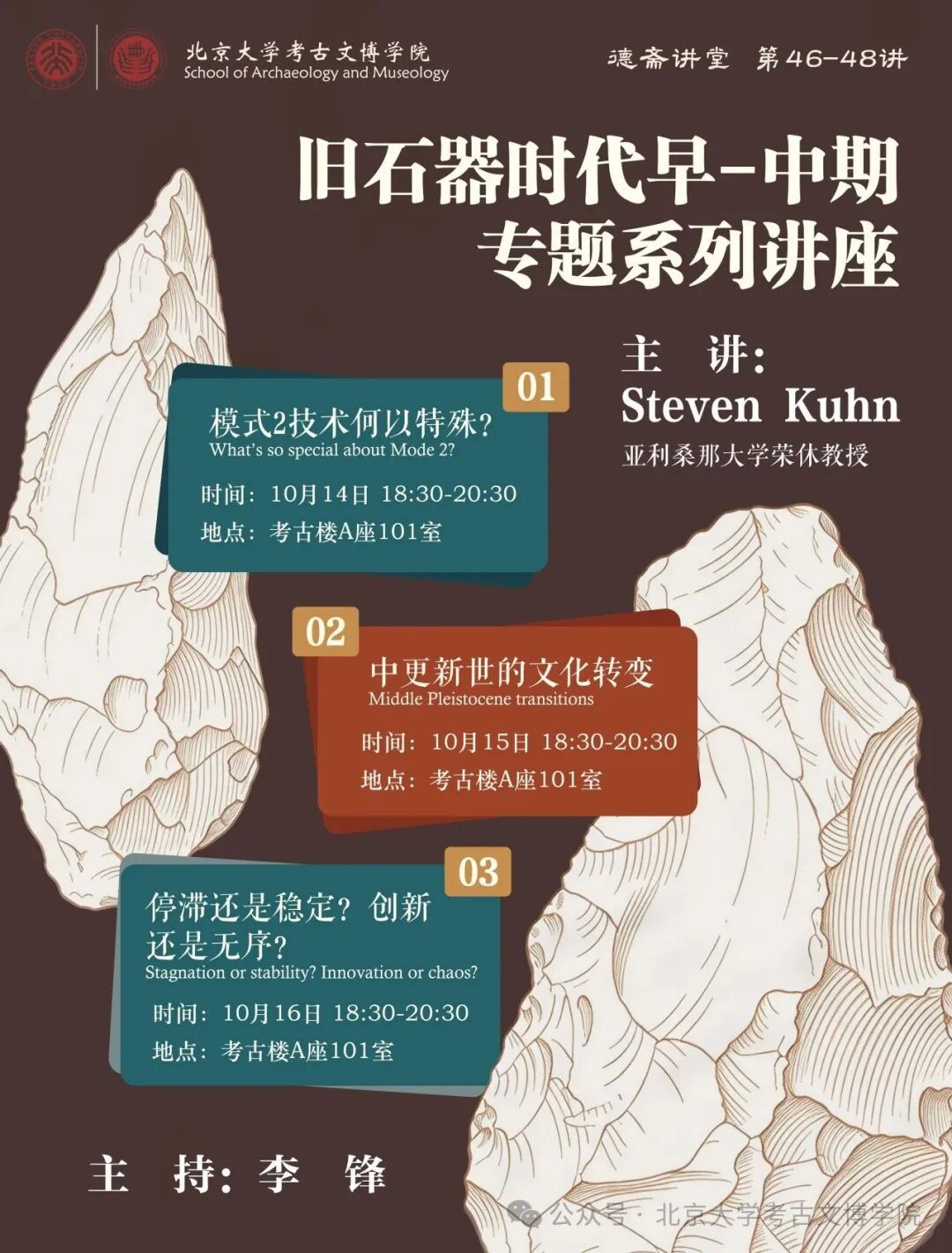
 Lecturer
: Steven Kuhn
Fred. A. Riecker Distinguished Professor Emeritus of Anthropology, University of Arizona
Host: Li Feng
Tenured Associate Professor, Peking University
Session 1:
Time: 18:30-20:30, October 14
Venue: Room 101, Building A, School of Archaeology and Museology
Theme: What’s so special about Mode 2?
Introduction:
Mode 2 or Acheulean lithic technology, and especially the iconic artifacts such as handaxes and cleavers, have occupied the attention of archaeologists and other scientists for more than a century. One enduring question is why Mode 2 technologies and artifact forms persist across vast areas for more than one million years. This lecture will review the evidence for stability and change across multiple domains of Acheulean assemblages. In the end, what persists are a few basic features of handaxes, the bauplan. What varies across time and space are the technologies by which the basic form is achieved and maintained. This reframes the basic questions about why the artifacts persist and what they imply about hominin behavior and cognition.
Session 2:
Time: 18:30-20:30, October 15
Venue: Room 101, Building A, School of Archaeology and Museology
Theme: Middle Pleistocene transitions
Introduction:
Hominin cultures of the Middle Pleistocene (Chibanian) stage have long been viewed as a sort of poorly defined transition phase, bridging more "important" developments of the Early and Late Pleistocene. Recent findings suggest that several fundamental changes in hominin culture and behavior unfolded during this period. These developments are known mainly from material culture and stone tools, but they have much broader implications for human evolution. This lecture reviews some basic findings about technologies and hominin biogeography during the Middle Pleistocene. Kuhn argues that two particularly consequential evolutionary developments, 1) the absolute dependence of hominins on technology, and 2) the re-organization of economic and social life around multi-purpose home bases, emerged during the latter half of the Middle Pleistocene, around 500,000-400,000 years ago. These developments had profound implications for subsequent cultural and cognitive evolution.
Session 3:
Time: 18:30-20:30, October 16
Venue: Room 101, Building A, School of Archaeology and Museology
Theme: Stagnation or stability? Innovation or chaos? Macroevolutionary change in the Middle Paleolithic and MSA
Introduction:
In western accounts of human cultural evolution, continuity in archaeological material culture is often interpreted as stagnation, whereas turnover in archaeological cultures is seen to represent creativity and innovation. In deep time, Paleolithic frames, innovation is seen as a feature of Homo sapiens, whereas stability or stagnation are thought to be typical of earlier hominins. This lecture will review case studies from Africa and Eurasia demonstrating that the same hominin taxa can exhibit radically different degrees of cultural continuity/turnover. The degree of stability or change in these cultural sequences is not related to the basic capacities of the hominins involved. Instead, it seems to be correlated with the scale of environmental variation or stability during the late Middle and Upper Pleistocene. These observations have a number of implications for how we understand culture change over long periods, and our expectations about dynamics of cultural evolution in different parts of the globe.