Editor's Note: “Southward Journey” is a path of progress brimming with hope and mission. It points to the vast Global South - a land full of vitality and challenges, where the most urgent needs and grandest visions of human development converge. The Institute of South-South Cooperation and Development at Peking University is dedicated to sharing the governance experiences of China and other developing countries, and cultivates high-level government officials for them. Batch after batch of graduates from ISSCAD, armed with the knowledge and broadened horizons they gained at Peking University and the deep friendships they forged, have taken up key positions in their home countries or international organizations, and have dove into the front lines of development, becoming the “stars” that illuminate the way forward.
As ISSCAD approaches its tenth anniversary, the National School of Development has organized a dialogue between current students and alumni. Together, they explore the common questions of development, embarking on a deep “co-research” journey that transcends the boundaries between theory and practice, connects local experiences with global perspectives, and integrates the wisdom of young people both at home and abroad.
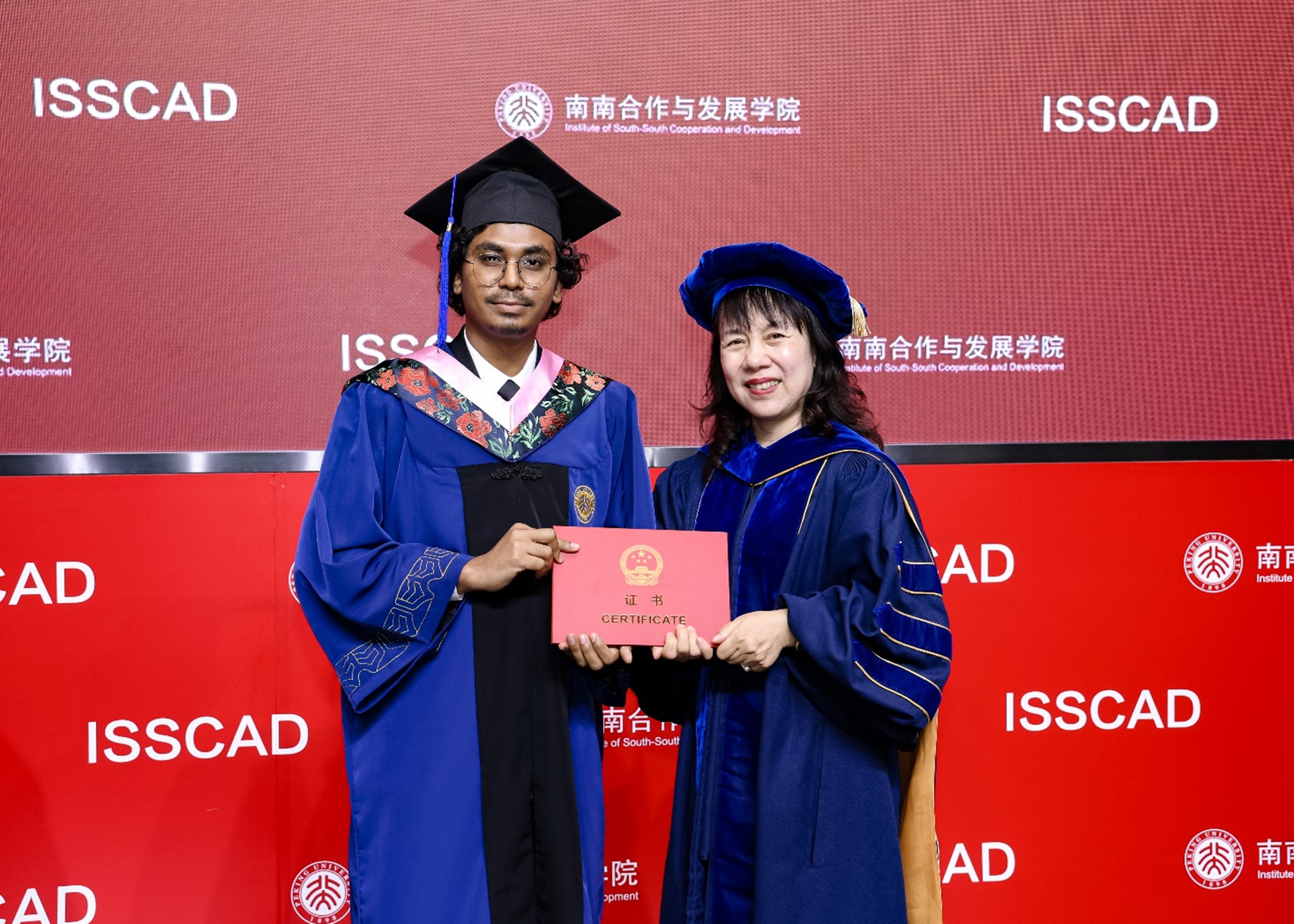
Misbah (left) and Prof. Lei Xiaoyan at the 2025 commencement of ISSCAD.
Peking University, May 6, 2026: Yousuf Misbah is a 2025 graduate of the Master of Public Administration (National Development) program at Peking University’s Institute of South–South Cooperation and Development, originally from the Maldives. In 2018, he earned a Bachelor’s degree in Psychology from Coventry University’s Sri Lanka campus; in 2022, he completed a Master’s degree in Social Policy at the Maldives National University and joined the Maldives President’s Office as Assistant Director for Social Policy and Research. In 2024, he enrolled at the ISSCAD to pursue his MPA. After graduation, Misbah will return to the President’s Office to continue advancing social protection and aging‑policy initiatives.
Multinational Quest: An Aspiring Journey
Before embarking on his studies in Beijing, Misbah’s academic and professional journey had already spanned several countries. He first completed a bachelor’s degree in psychology at Coventry University, in the Sri Lanka campus, where he developed a deep interest in human development and public policy. After returning to the Maldives, he earned a master’s in social policy at the Maldives National University, while working at the President’s Office as Assistant Director for Social Policy and Research, designing, evaluating, and monitoring support programmes for vulnerable groups. In that role, he observed that the Maldives was hurtling toward “deep aging” in just thirteen years, yet its national response to such issues remained piecemeal and uncoordinated.
In order to better serve the Maldivian people and society in the future, he began searching for an academic programme that balanced theory and practice. After thoroughly comparing curricula, faculty profiles, and international partnerships across several options, Misbah set his sights on the Master of Public Administration programme at Peking University’s ISSCAD. On one hand, ISSCAD is tailored for mid career government officials, with a curriculum closely aligned to the real world needs of developing countries; on the other hand, it emphasises a “Global South” perspective, enabling him to draw on China’s advanced practices in public management and social protection while incorporating lessons from other developing nations. In the end, this combination of a government focused cohort and a multi regional outlook perfectly matched his need to translate broad policy understanding into concrete response strategies.

Misbah at the 2024 opening ceremony of ISSCAD.
Silver Ageing Focus: A Grounded Study
ISSCAD’s MPA programme is known for its “short timeframe and heavy workload.” Students are expected to complete all coursework and their thesis within a single academic year. At the start of the second semester, Misbah promptly chose Professor Lei Xiaoyan as his advisor and finalized his thesis topic and research framework with her. Initially drawn to the concept of the “silver economy,” he ultimately narrowed his focus—after thorough discussions—to the demographic shift itself and its dual social and economic impacts. In reviewing the Maldives’ current policies, he found that the first aging policy, introduced in 2018, has not been succeeded by a unified framework, creating gaps in policy documentation; while the country has adopted community eldercare centres modeled on Chinese and Japanese examples and maintains a basic social security system, it continues to neglect investment in senior skills development and their economic participation, and the retirement age—set at 65—also warrants reconsideration.
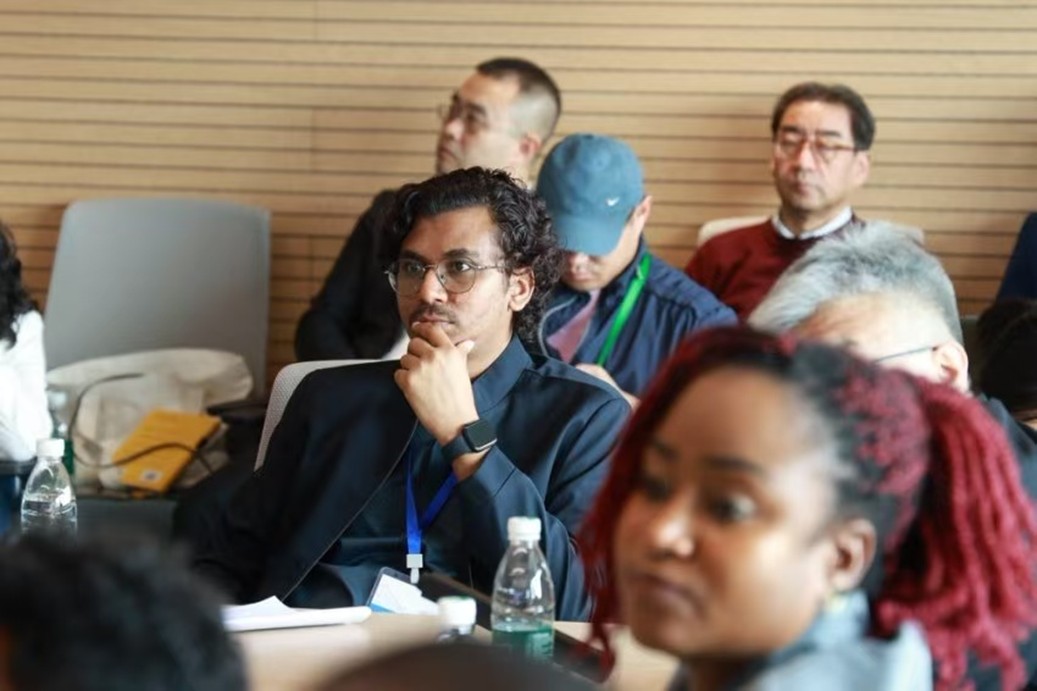
Misbah attended a lecture at Tencent.
In his master’s thesis, Misbah focused on the Maldives’ rapid demographic transition—declining fertility rates, increasing life expectancy, and a rising proportion of elderly citizens—to examine its multifaceted implications for socioeconomic sustainability. Employing a convergent mixed methods approach, he quantitatively analyzed demographic data from 1970 to 2050, finding that the share of individuals aged 60 and above is projected to climb from 8.3% in 2022 to over 34% by 2050; concurrently, he conducted a qualitative evaluation of existing policy frameworks alongside a comparative case study of Mauritius to comprehensively assess the Maldives’ economic resilience, social protection system, and policy preparedness. The study found that, despite significant progress in expanding pension coverage and healthcare access, institutional gaps persist in long term care, geriatric healthcare, pension sustainability, and the elderly’s participation in the labor market. Based on these findings, Misbah advocates for a life course, rights based strategy that reconceptualizes older individuals as active contributors to society; his recommendations include enhancing interministerial coordination, scaling up long term care infrastructure, reforming the pension system, and harnessing the potential of the “silver economy” to build a more comprehensive and sustainable aging response framework.
Additionally, to enrich his analyses, he drew on literature and lectures from the Global Health module to study China’s response measures. China’s newly issued “Silver Economy” development guidelines—designed to promote social–economic integration and ensure older adults are not marginalized—served as a key reference. What impressed him most was the high level of digital literacy among Chinese seniors: they are adept at mobile payments and online health services. During his research visit to Tencent, he observed how AI-driven health monitoring and remote care solutions, leveraging Internet of Things technologies, are being applied in eldercare. These real-world practices provided valuable insights for the policy evaluation case studies in his thesis. They may offer practical lessons for the Maldives as it designs its aging response strategies.
After graduation, Misbah plans to return to his current position at the President’s Office, where he continues to oversee policies on social protection and service delivery. He aims to apply the insights and methods gained at ISSCAD to strengthen the Maldives’ social protection frameworks and promote more integrated, forward-looking policy solutions. At the same time, he is also exploring new opportunities where he can fully apply his expanded skill set and contribute more strategically to national and regional development efforts.
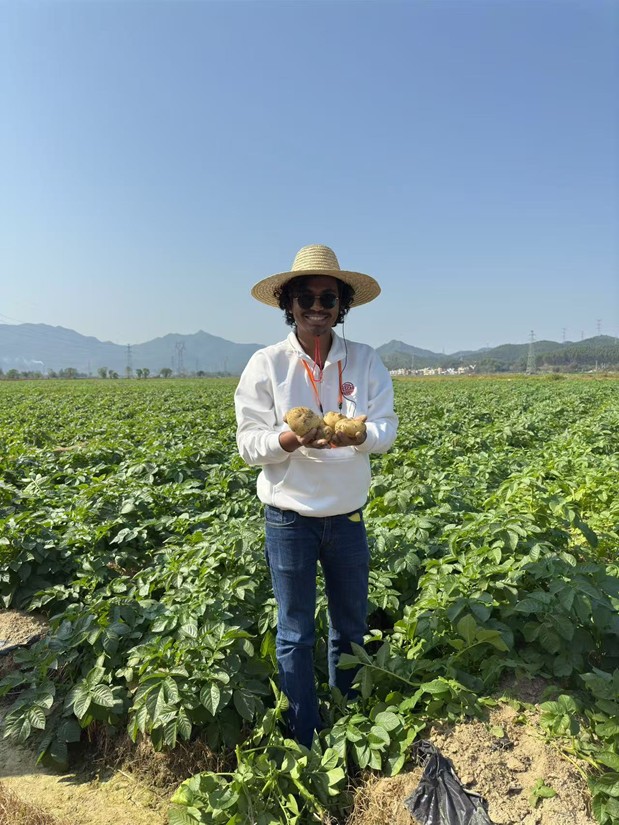
Misbah conducting field research at a potato plantation base in Huidong County, Huizhou, Guangdong Province.
Yan Garden Impressions: A Cultural Discovery
At Peking University, Misbah discovered that he was one of only a handful of students from the Maldives, yet he quickly found friendship on campus. Students at ISSCAD come from diverse cultural backgrounds—Africa, Asia, Latin America, and beyond—and although their initial ways of interacting sometimes differed, they soon connected across national and cultural lines. Faculty often said, “We are one family here; once you become part of the family, everyone takes care of you.” It was within this welcoming, inclusive environment that Misbah rapidly integrated into both the academic and social life of the college.
When speaking of his everyday life in Beijing, Misbah often highlights the food. He recalls, “I was first struck by how clean and orderly Beijing is. What I love most are the people and the endless opportunities to discover delicious food. I enjoy wandering around—even though my friends often complain—but I feel like I uncover new parks and historical sites; it feels like an adventure.” From street snacks in the hutongs to authentic roast duck restaurants, these culinary experiences have become some of his most memorable taste memories during his time studying in Beijing.
For incoming international students at ISSCAD, Misbah offers two pieces of advice. First, for everyday life, install and become proficient with translation and travel apps. He relied on his phone’s translation tools to read street signs in Beijing’s hutongs and to order local snacks—these “small encounters” helped him adapt to the city’s rhythm more quickly. Second, maintain curiosity and critical thinking: don’t arrive with fixed conclusions, and be willing to challenge your preconceived notions about a country’s policies and culture.
Misbah’s journey of discovery at Peking University is a vivid microcosm of how ISSCAD nurtures “development starlight.” Bearing profound insights into the Maldives’ “silver wave” and the wisdom honed at Yanyuan, he now returns home to write a new chapter in his country’s development blueprint. We believe this light, shining across the Indian Ocean, will not only illuminate his path but also strengthen the bonds of South–South cooperation—sowing hope and kindling the flame of progress throughout the vast expanse of the Global South.
Interviewed and edited by: Cai Yujie
Source: ISSCAD