 Peking University, July 22, 2026
: Hailstorms are sudden weather events that can damage crops, homes, vehicles, and infrastructure within minutes. Scientists have long been unsure whether global warming will make future hailstorms more or less damaging. A team led by Professor Zhang Qinghong from Peking University, together with Professor John T. Allen from Central Michigan University, has now provided the first global estimate of how hail size and damage potential may change in a warmer climate. Their new study, titled “Rising global hail damage potential in a warming world,” has been published in
Nature.
Why it matters
Hail is difficult to study because storms are small, short-lived, and recorded differently across countries. Hailstone growth and melting are also controlled by complex processes inside thunderstorms. This low predictability, combined with hailstorms’ destructive power, makes hailstorms a major driver of insurance losses and socioeconomic damage.
Key findings
The research team analyzed 14,297 historical severe hail events worldwide and simulated how hail damage potential would change under different future greenhouse gas emission scenarios. The results show that future hail will generally shift toward larger hailstones near the ground. By the end of the century, hailstones smaller than 30 millimeters are expected to become 4%–12% less common, while hailstones larger than 30 millimeters may become 38%–52% more common. The total kinetic energy of hail reaching the surface could increase by 37%–42%, with larger increases under higher emissions.
Warming affects hail in two opposite ways. A warmer and wetter lower atmosphere can create stronger updrafts and provide more liquid water, helping hailstones grow larger. At the same time, a higher melting layer makes hailstones fall through a deeper warm layer. Small hailstones may melt before reaching the ground, while larger ones are more likely to survive.
Hail damage is expected to increase most in northeast China, Europe, and the Great Plains of the United States. Some tropical and monsoon regions, including equatorial Africa and Southeast Asia, may see smaller hail and lower damage potential because melting outweighs growth.
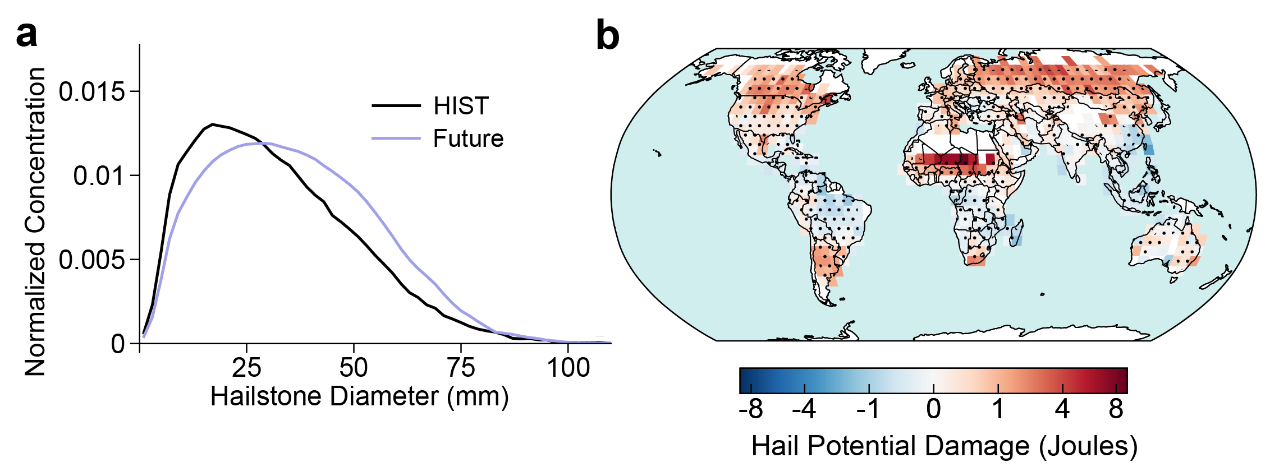 Figure 1. (a) Near-surface hail size distributions under historical and future climate scenarios; (b) Spatial distribution of projected changes in global hail damage potential under the SSP5-8.5 scenario.
Future implications
Figure 1. (a) Near-surface hail size distributions under historical and future climate scenarios; (b) Spatial distribution of projected changes in global hail damage potential under the SSP5-8.5 scenario.
Future implications
The study supports future disaster planning, crop protection, building design, insurance assessment, and climate adaptation. It shows that hail risk may not rise everywhere, but many mid-latitude regions could face much more damaging hail by the end of the century.
*This article is featured in PKU News "Why It Matters" series. More from this series.
Read more: https://www.nature.com/articles/s41586-026-10543-2
Written by: Akaash Babar
Edited by: Chen Shizhuo
Source: PKU News (
Chinese)