Peking University, Oct 23, 2026: A robot arm that bends like an elephant's trunk can slip into tight spaces and handle fragile objects. Controlling it is harder, because its smooth bending makes its next move hard to predict. Researchers have now developed a method that keeps computer predictions of the arm's motion on track, even when the arm moves faster than the model was trained for.
The study comes from a team involving Professor Xie Guangming and Professor Zhang Feitian at Peking University's School of Advanced Manufacturing and Robotics. It was presented at Robotics: Science and Systems (RSS 2026), held in Sydney, Australia, from July 13 to 17, 2026.
Why it matters
Before a flexible robot moves, its controller often rehearses possible commands in a computer model and picks the best one. Models trained by data predict one small step at a time, and each step starts from the last, so small errors pile up. After 200 steps, the forecast can be far off, and the robot can be working from a false picture of its own body.
Key findings
The team's idea is to give the forecast a reference point. One model, the anchor, learns the shape the arm settles into whenever its controls are held steady. At every step, it pulls the prediction back toward that shape, so errors cannot snowball. But the arm swings and bends on its way to rest, so a second, lightweight model, the correction, learns those dynamics from the arm's motion data. Together they form a hybrid model (Figure 1).
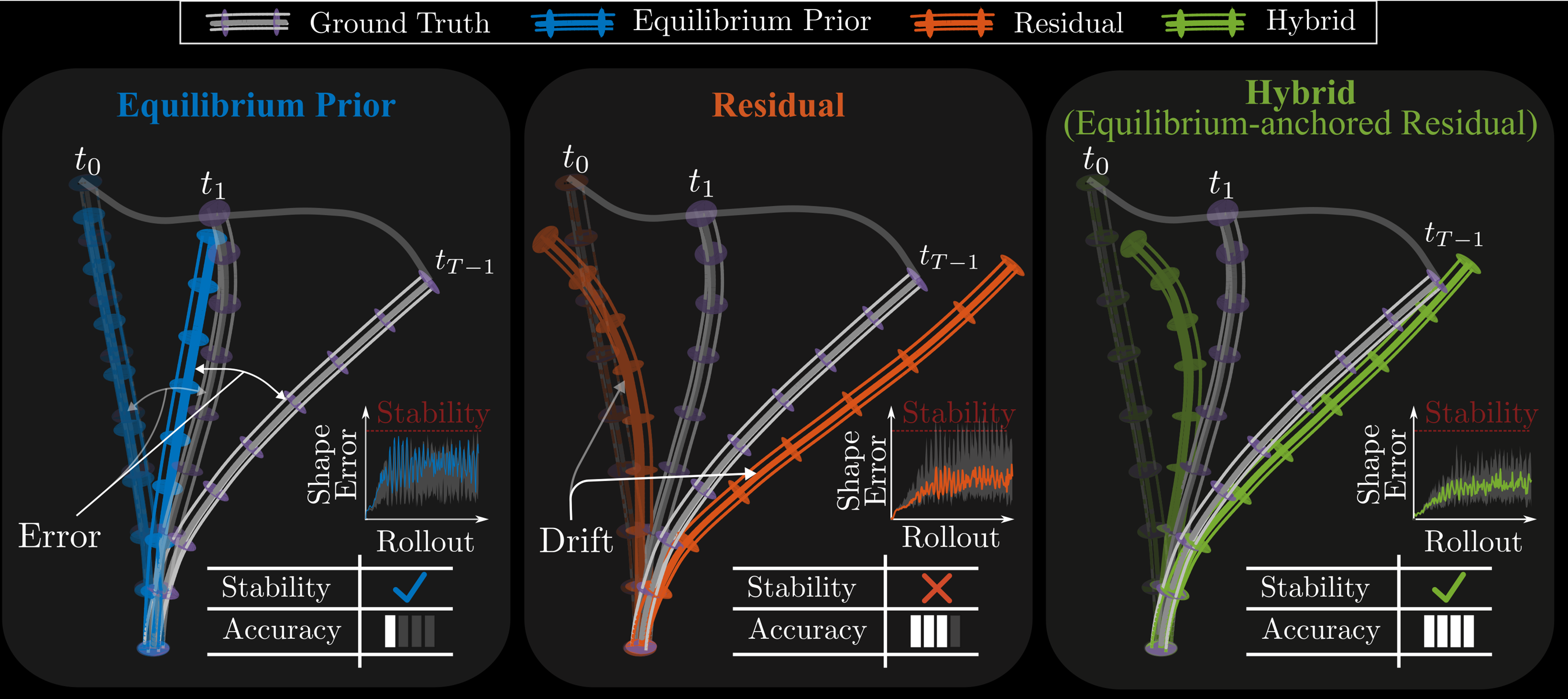 Figure 1. Three ways to forecast where the arm goes next. The blue forecast stays steady but misses the swing, the orange one drifts off course, and the green one, which combines both ideas, stays closest to the real motion (gray).
The team first tested the idea in simulation, on a three-dimensional arm driven by cables. Asked to predict six seconds of motion, or 200 steps, well outside what it was trained on, the hybrid model cut its error by more than a quarter compared with the anchor alone. It also beat the correction alone and never lost track in any of the 19 tests.
Then came a real machine: a hydraulic soft fish-like tail that swings from side to side when pressurized. Here the hybrid model's error was half or less that of the anchor alone, and a quarter or less that of the correction alone. On standard benchmark tests, it also finished every prediction, while a competing method sometimes failed.
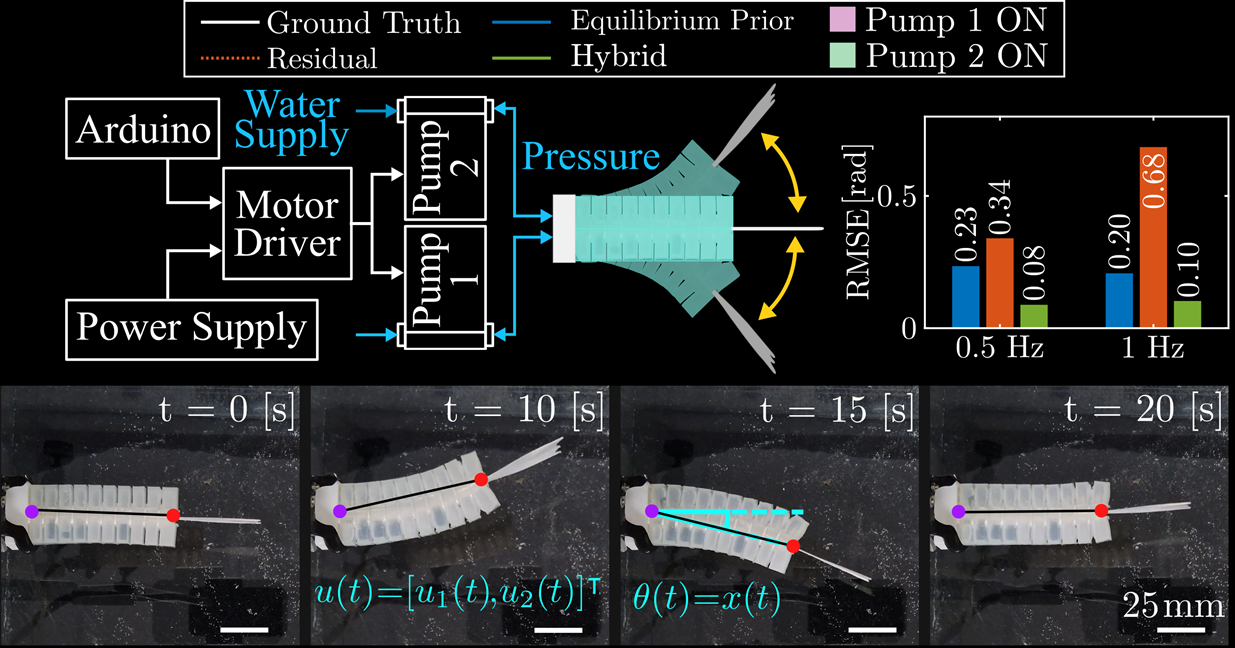 Figure 2. A soft robotic tail that swings from side to side as water is pumped in. At both swing speeds, the green forecast, from the combined method, makes the smallest errors.
Future implications
Steadier predictions give a robot's controller something it can trust. It could try out many possible moves in the computer first and choose the safest one before the real arm moves. A robot that can foresee how its own body will bend can plan a careful move before it makes one. That could help flexible arms work in places rigid machines struggle to reach, such as tight spaces, and with objects that break easily.
*This article is featured in PKU News "Why It Matters" series.
More from this series.
Read more: https://doi.org/10.15607/RSS.2026.XXII.106
Website: https://anchored-rollouts.github.io/
Source: School of Advanced Manufacturing and Robotics, Peking University
Edited by: Chen Shizhuo